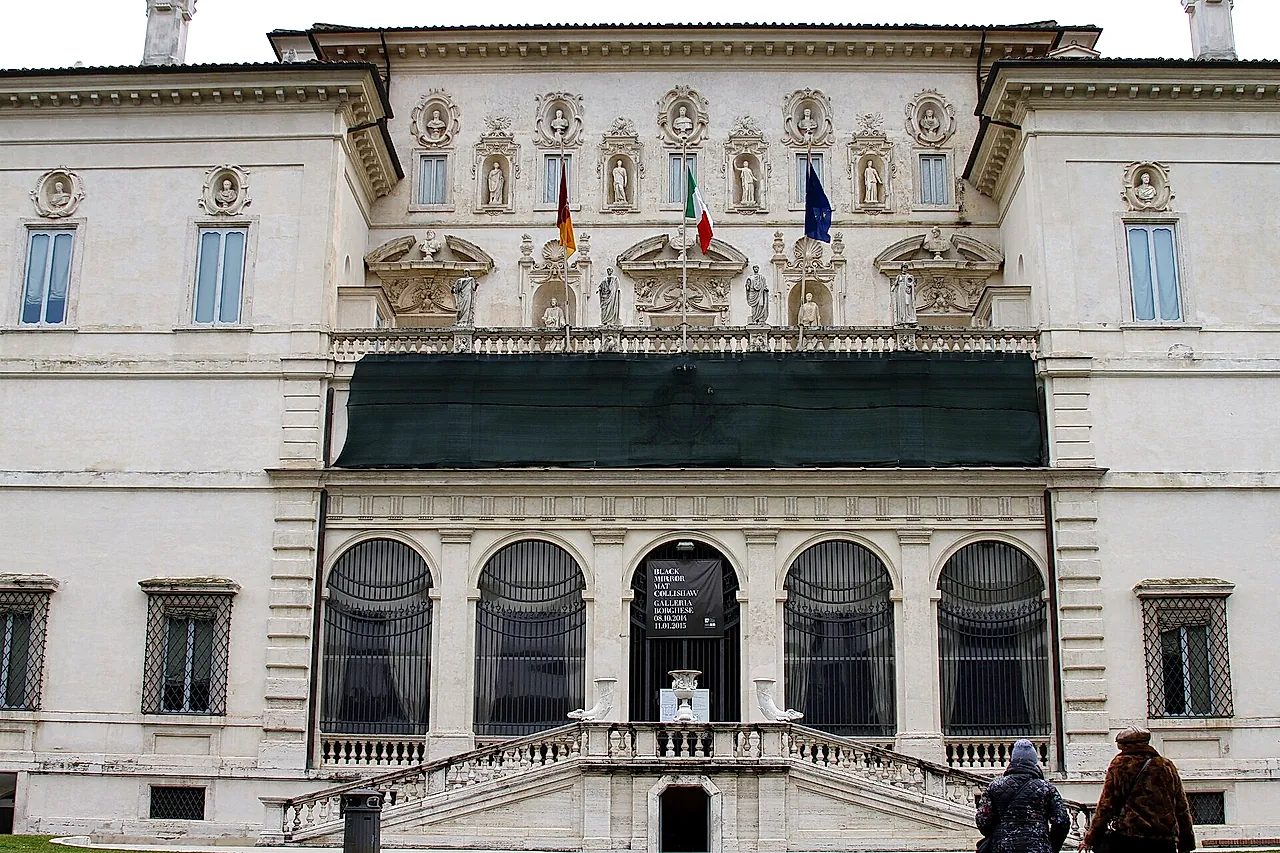
Rome · Villa Borghese · Piazzale Scipione Borghese
Borghese Gallery: tickets, hours and what to see
Bernini's sculptures and Caravaggio's paintings in a villa inside the Villa Borghese park. Everyone needs a reservation and enters in two-hour slots.
Today
Opening hours for every month are on the Opening hours page.
Checked against the official website on 23 October 2026 · Official source
In short
- The Galleria Borghese is open Tuesday to Sunday from 9:00 to 19:00, with the last entry at 17:45. It is closed on Mondays, on 25 December and on 1 January. Hours read on the official site on 23 October 2026.
- Booking is compulsory for everyone, children and free tickets included. You enter only at the start of each hour, in a slot of two hours, and you leave when it ends. The same slot rule applies to every ticket, whoever sells it.
- Official price: 18 € (16 € ticket + 2 € booking), or 13 € for the 17:45 slot. EU citizens aged 18 to 25 pay only the 2 € booking, and under-18s and some other categories enter free apart from that fee. Tickets cannot be changed or refunded.
- The tickets and tours on this site are sold by our partner Tiqets, a third party, which sets its own prices: the reserved entry is listed at 50 € at the time of writing, with a mobile ticket delivered at once, according to Tiqets. The museum sells its own tickets through its ticketing operator.
- Travel light: backpacks and medium or large bags go to a cloakroom with limited space, and food and drinks (water too) are not allowed. The park around the Gallery, Villa Borghese, is free and is a separate place from the museum.
Bernini's sculptures for Cardinal Scipione
Gian Lorenzo Bernini made several of his early masterpieces for Cardinal Scipione Borghese. The museum's online catalogue dates Aeneas, Anchises and Ascanius to 1619, the Rape of Proserpina to 1621-1622, David to 1623-1624 and Apollo and Daphne to 1622-1625. All four are on the ground floor, in rooms 6, 4, 2 and 3.
Apollo and Daphne catches the moment in which Daphne turns into a laurel tree, a scene from Ovid's Metamorphoses. The Rape of Proserpina was made for Scipione too, but it passed to the Ludovisi family and was bought by the Italian state only in 1908, according to the catalogue. Room numbers can change with new displays, so check the museum's site.
Caravaggio, Titian, Raphael and the paintings
According to the online catalogue, five paintings by Caravaggio are in room 8, the Sala del Sileno, on the ground floor: Boy with a Basket of Fruit (about 1595), the Madonna dei Palafrenieri (1605), Saint Jerome (about 1606), David with the Head of Goliath (1606-1607 or 1609-1610) and Saint John the Baptist (1609-1610). A sixth, the Self-Portrait as Bacchus (the Sick Bacchus), is listed there as "not on display" on 23 October 2026.
Most of the other masterpieces are on the first floor. Titian's Sacred and Profane Love (1515-1516) and Antonello da Messina's Portrait of a Man are in room 20, and Raphael's Deposition (1507) is in room 9. The museum's own pages name Caravaggio, Raphael, Titian, Correggio, Antonello da Messina, Giovanni Bellini, Bernini and Canova among the artists in the collection.
Canova's Pauline Borghese as Venus Victrix
In room 1, the Sala della Paolina, Antonio Canova shows Pauline Borghese Bonaparte as Venus Victrix, reclining on a couch (1804-1808). The commission came from her husband, Camillo Borghese, and according to the catalogue the couch hides a mechanism that turned the figure.
A villa built for a collector
The Casino was built for Scipione Borghese, nephew of Pope Paul V (elected in 1605). Work began in 1607 under Flaminio Ponzio and was substantially finished in 1613; Giovanni Vasanzio, a Fleming also known as Jan van Santen, completed it. From 1770 Marcantonio IV Borghese had the rooms redecorated with the architect Antonio Asprucci. In 1807 a sale imposed by Napoleon took the cardinal's ancient sculptures out of the villa, according to the official site.
The museum belongs to the Italian state and is part of the Ministry of Culture. Its public rooms are 20 frescoed rooms, the portico and the entrance hall.
Villa Borghese, the park: free and separate
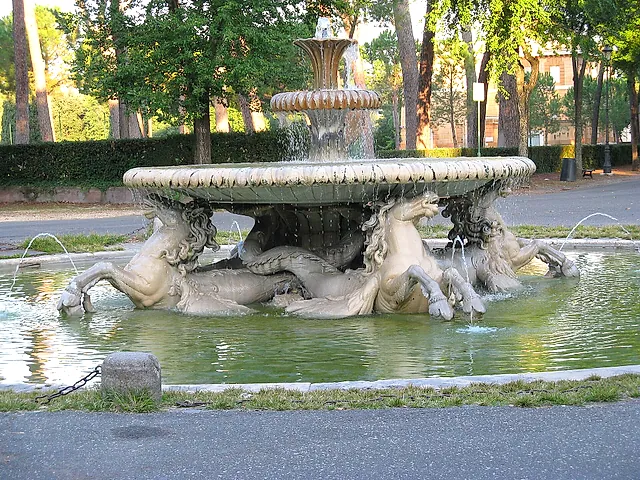
The Gallery stands inside the public park of Villa Borghese. The park is free to enter, while the Gallery needs a ticket with a compulsory booking, and the official FAQ stresses the difference. The nearest park entrance is on Via Pinciana. We do not give park opening hours because the sources we found disagree.
Other museums in the park, such as the Galleria Nazionale d'Arte Moderna or the Etruscan Museum of Villa Giulia, are separate places with their own tickets and hours, which we have not checked. We found no combined ticket with the Galleria Borghese on the official site.
The Pincio and Piazza del Popolo
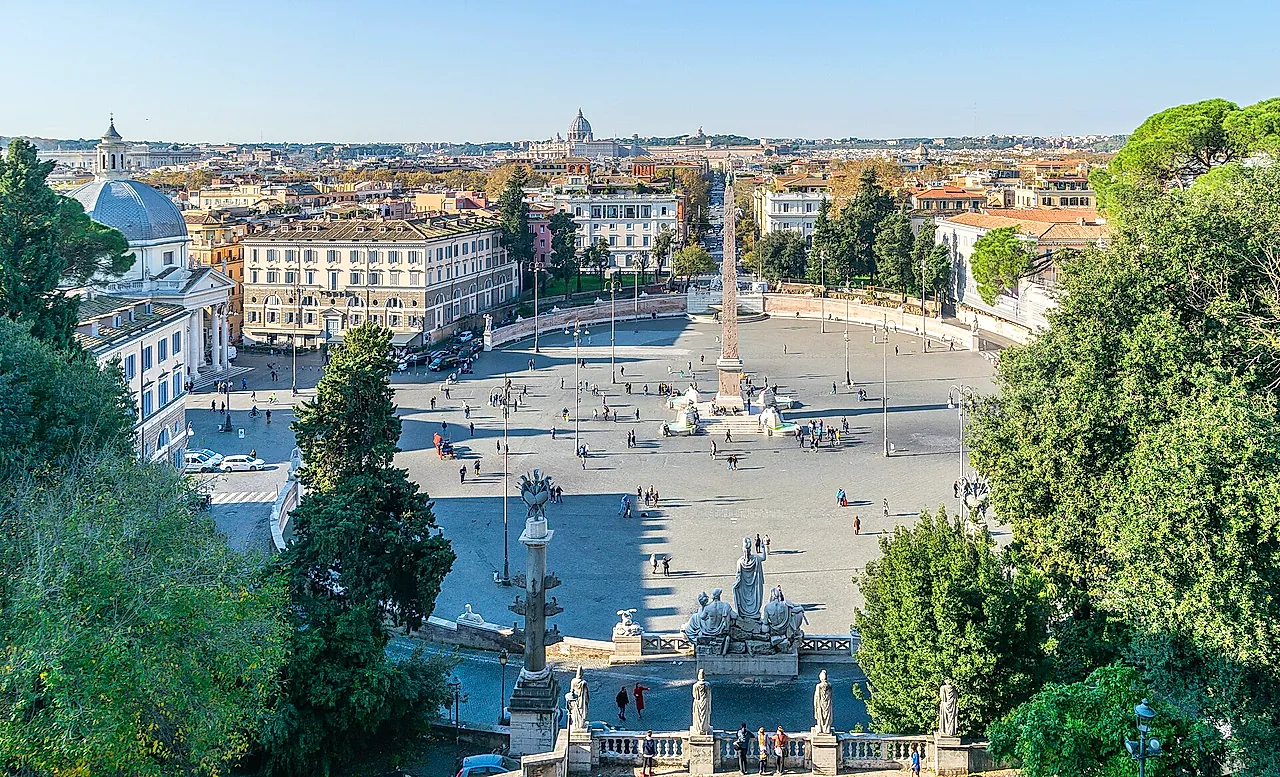
The terrace of the Pincio, at the edge of the park, looks over Piazza del Popolo. As the crow flies, the Pincio is about 1.1 km from the Gallery and Piazza del Popolo about 1.4 km. These are map distances, not walking times, which we have not measured.
Bags, food and photos: the rules
The official site allows only small belt bags and pouches up to 21 x 15 cm. Medium and large bags, shopping bags, backpacks, luggage, umbrellas and selfie sticks go to the cloakroom, which takes only limited luggage while space lasts, and the museum does not guarantee storage. The ticketing operator's page is stricter and says all bags must be left: leave everything you can.
Food and drinks, water included, and animals other than guide dogs are not allowed. The official site's page on photography says that reproducing works for personal, non-profit purposes is free if you use no flash or tripod and do not touch them. We found no general ban in the rooms, but the management can ban photography for particular displays or exhibitions, so look for signs.
Visitor guide
Borghese Gallery Tickets: Prices, Time Slots, Sold-Out Tips
Galleria Borghese tickets: booking is compulsory, visits last 2 hours, official price 18 euros (16 + 2), free days and what to do if your slot is sold out.
What to See at the Borghese Gallery: Bernini, Caravaggio, Canova
What to see at the Galleria Borghese in Rome: Bernini's sculptures, Canova's Pauline, five Caravaggios, Titian, Raphael, rooms and the 2-hour limit.
Borghese Gallery Visit Tips: Slots, Bags, Park, Getting There
Tips for the Galleria Borghese in Rome: slot punctuality, bags and cloakroom, photos, accessibility, audio guide, Villa Borghese, how to get there.